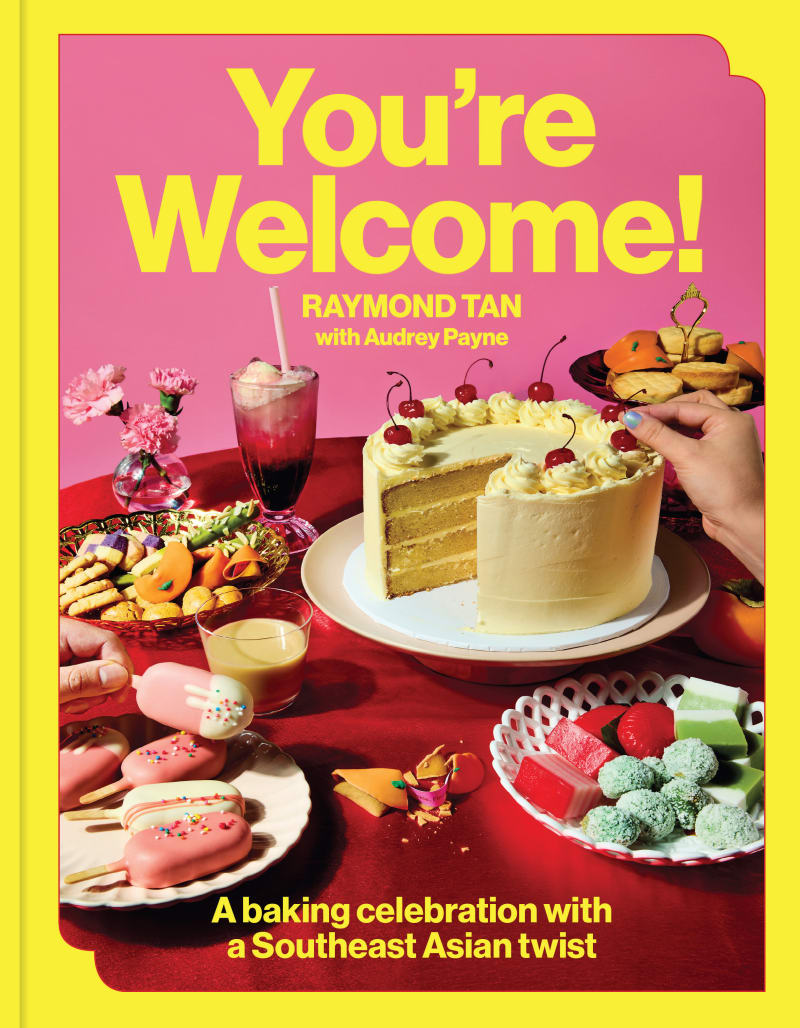
Raymond Tan is a baker, pastry chef and co-founder of Raya Bakery and Dua Bakehouse in Melbourne. Known for his contemporary take on Southeast Asian flavours, Tan draws on the food, memories and traditions he grew up with, blending nostalgia with modern Western techniques – and sometimes the other way around. Through his bakeries, he has built a devoted following for desserts that celebrate his heritage while feeling fresh, familiar and uniquely Australian.
Here he is with the download on his brand-new baking book, You’re Welcome!
I wrote You’re Welcome! because it feels timely. The flavours and textures I grew up with are finally having a moment and being celebrated in a way I never imagined.
But I also wrote it because it felt like an impossible dream. What started as a hobby in my small apartment kitchen eventually turned into a career in food, and I never thought there would be such an appetite for the flavours and recipes I grew up with.
The book became a way for me to reflect on where I came from, how I celebrate my culture and traditions while living abroad, and why food remains such an important way to connect with people.
The main thing I learned writing it was that I wasn’t just documenting recipes; I was documenting my growth as a baker, along with the relationships, places and moments that shaped me along the way.
Recipes are what I’m most familiar with, but each one seemed to unlock story after story: memories of my aunties making certain dishes, the desserts and cakes I’ve baked for friends’ birthdays and weddings, how I’ve come up with recipes with my team in my bakeries, and even dishes that reminded me of my grandmother’s funeral.
Writing the book taught me that recipes are rarely just instructions. They’re vessels for culture, memory and connection.
If you’re planning on baking from You’re Welcome!, a few essential Southeast Asian ingredients you could stock up on are pandan, coconut milk, palm sugar and ube. These ingredients appear throughout Southeast Asian cooking and baking, bringing distinctive flavours that are difficult to replicate with substitutes.
Pandan adds a fresh, vanilla-like fragrance, coconut milk provides richness and depth, palm sugar contributes complex caramel notes, and ube offers beautiful colour and earthy sweetness.
Together, they form the foundation of many recipes in the book.
If you take one thing from this book, it should be…
Cooking and baking started for me in a small apartment kitchen as a hobby. It wasn’t particularly intimidating or romanticised – it was simply something I enjoyed doing.
Many of the flavours and recipes in this book may seem unfamiliar to some readers, but they’re often built on simple techniques and accessible ingredients.
I hope the book gives people the confidence to explore Southeast Asian flavours in their own kitchens and discover that they’re far more approachable than they might seem.
I’d also love it if you tried the pandan chiffon cake. It’s been on our counter since day one and has become one of our signature bakes. To me, it perfectly captures the balance of tradition and everything I love about a cake: light, fragrant, fresh and comforting.
It’s the cake that almost everyone across Southeast Asia seems to have grown up with in one form or another. For me, the aroma of pandan instantly brings back memories of family gatherings, trips to the grocery store and celebrations. It’s a flavour that’s deeply nostalgic, yet somehow still feels fresh every time I encounter it.
It looks impressive, tastes even better, and is guaranteed to fill your kitchen with one of the best aromas imaginable.
If you’re a relatively new cook, give the miso peanut cookies a try. A bit of an underdog, these are one of our festive must-haves. They’re the kind of recipe that delivers maximum reward for relatively little effort.
The dough comes together quickly, the ingredients are easy to source, and the techniques are straightforward enough for even a beginner baker. At the same time, the combination of sweet and savoury miso cookie dough with rich roasted peanuts creates a flavour that’s familiar, nostalgic and surprisingly addictive.
They’re also a great introduction to the way I like to bake: taking familiar techniques and pairing them with flavours that might be new to some readers.
Once you’ve mastered these cookies, you’ll have the confidence to tackle many of the other bakes throughout the book.
If you’re looking to extend yourself a bit more, meanwhile, try tackling one of my layer cakes. They’re a labour of love that rewards patience, and you’ll be mastering multiple dessert elements at once.
When you’ve finished reading You’re Welcome!, I hope you’ll get celebrating and make something for the people you care about.
I hope the recipes in this book encourage you to gather friends and family around the table, share stories and create new traditions of your own. Perhaps you’ll discover a deeper connection to your heritage, find joy in feeding others, or even be inspired to pursue a career in food.
Whatever you take from these pages, I hope it reminds you that food is one of the simplest and most meaningful ways we can connect with one another.
And if you’re thanking me for all these amazing recipes… you’re welcome!