
Just over two years ago, pastry chefs Hyoju Park and Rong Yao Soh opened Madeleine de Proust, a tiny bakery churning out their namesake treat to a small but dedicated fanbase.
Several seasons in, and Park and Soh’s micro-bakery is a must-stop on Melbourne’s sweet treat circuit, with passionate pastry lovers forming a mostly orderly queue often before the doors have opened in the morning. It’s madeleine madness, and the good news is there’s now another way to get in on the action – from the comfort of your own kitchen – thanks to their debut cookbook Madeleines.
Here’s Hyoju Park and Rong Yao Soh now with how the book came be, and the necessary skills to create that perfect little hump in your own madeleines.
We wrote Madeleines…
Hyoju Park and Rong Yao Soh: …because, for us, this small shell-shaped cake holds a lot of meaning. It’s quite technical and precise, but at the same time it can bring back memories in just one bite. That idea of taste and memory is very important to us – it’s where the name of our bakery comes from, inspired by Marcel Proust – and it’s something we always think about when creating new flavours.
As chefs, we pay a lot of attention to details – how we prepare the mould, how much batter we fill, the temperature, the timing. We wanted to share not just the recipe, but also the reason behind each step, so home bakers can understand and recreate it. This book is our way of opening that process – the parts people don’t usually see when they just enjoy a madeleine.
The main thing I learned writing it…
Hyoju Park: …was that what feels natural in a professional kitchen is actually made up of many small, careful decisions. When we bake, we are always checking small details – how the batter flows, if the mould is prepared properly, if the eggs are mixed well, if the butter is at the right temperature – because as a pastry chef, you learn to be very precise.
Madeleines are quite sensitive, and they don’t really hide mistakes, especially if you want that nice hump and soft texture. But at the same time, I realised not everyone needs to be a perfect baker to bake something beautiful. So while writing, we tried to simplify things a bit and find a balance – keeping the important details, but making it more approachable for home bakers.
For me, it felt like organising all the knowledge in my head and sharing it in a clearer way, almost like teaching. I think I learned to be more patient, and to explain things in a way that others can understand and feel confident to try.
Madeleines aren’t always as intimidating to make as you’d think. The three things to keep in mind while making them are…
Rong Yao Soh: First: honestly, all the tricks are quite simple – it just takes a bit of patience. Prepare your mould properly. Different mould materials behave differently, and getting a clean release is already half the job. We use slightly different approaches depending on the mould and even the recipe, and that’s something we explain in the book.
Second: fill consistently. Aim for around 80 per cent full. This helps you get an even crust and that signature shape, without overflow – even if your mould size is slightly different from the one in the recipe.
Third: respect temperature and timing. In our recipes, we sometimes warm mixtures to specific temperatures and start with a higher oven heat before reducing it. It might sound small, but these steps are what help create the rise and give you the right texture.
In the end, it’s not about complicated techniques – it’s about doing the simple things properly.
If you take one thing from this book, it should be…
RYS: …that madeleines are incredibly versatile – but only once you understand the basics properly. We structured the book so you learn the foundations first: how to prepare your mould, how to mix the batter, and how to work with fillings and coatings, so you can achieve consistent results each time.
Once you have that, the flavours become something you can really play with. You can change the base, change the filling, change the appearance, even change the mould – and it becomes something very personal. For example, creations like the Poppin’ Corn madeleine, Pink Carnation madeleine, or even the Cheese Onigiri madeleine all come from the same foundation, just expressed in different ways.
But more than anything, we hope this feels inspiring from a home baker’s perspective – that you don’t need to follow everything exactly, but instead feel confident to explore and create something that feels like your own.
For us, we always try to think a little outside the box. The recipes in the book give you the flavour and the concept, but from there, you can make it your own.
If you’re a relatively new cook…
HP: …give the lemon or yuzu madeleine a try. It’s one of the base recipes we come back to again and again, and it teaches you the essential steps – how to prepare the mould, mix gently, glaze cleanly, and understand your oven – without needing to handle fillings or more complex elements at the start.
The ingredients are also easy to find in most supermarkets, which makes it a very approachable place to begin. And once everything is prepared, you can enjoy the smell and the taste in about 30 minutes, which makes the process feel very rewarding.
If you’re looking to extend yourself a bit more, meanwhile…
HP: I’d suggest trying some of the finishing elements – like filling your madeleines, working with ganache, or adding a chocolate coating. Once you start doing that, it becomes a bit more hands-on. You need to think about things like when to fill, how to get a clean finish, and how everything comes together in the end. It’s a nice step forward, where a simple madeleine becomes something a bit more refined – still easy to enjoy in one or two bites, but with more layers and detail.
When you’ve finished reading Madeleines, we hope you’ll bake with curiosity and a little bravery – the kind that comes from understanding what you’re doing, not just hoping it works. The book goes into quite a lot of detail, but at the same time, the ingredients are simple and easy to find, so it feels approachable to start.
We also hope you’ll find (or create) your own “madeleine moment”: a flavour that brings you back to someone, somewhere, or a version of yourself. Even with the most classic recipe, I feel like there’s always something personal you can add, or a memory you can connect it to.
If the book helps you slow down and notice how memory and craft can come together in a single bite, then it has done what we hoped.
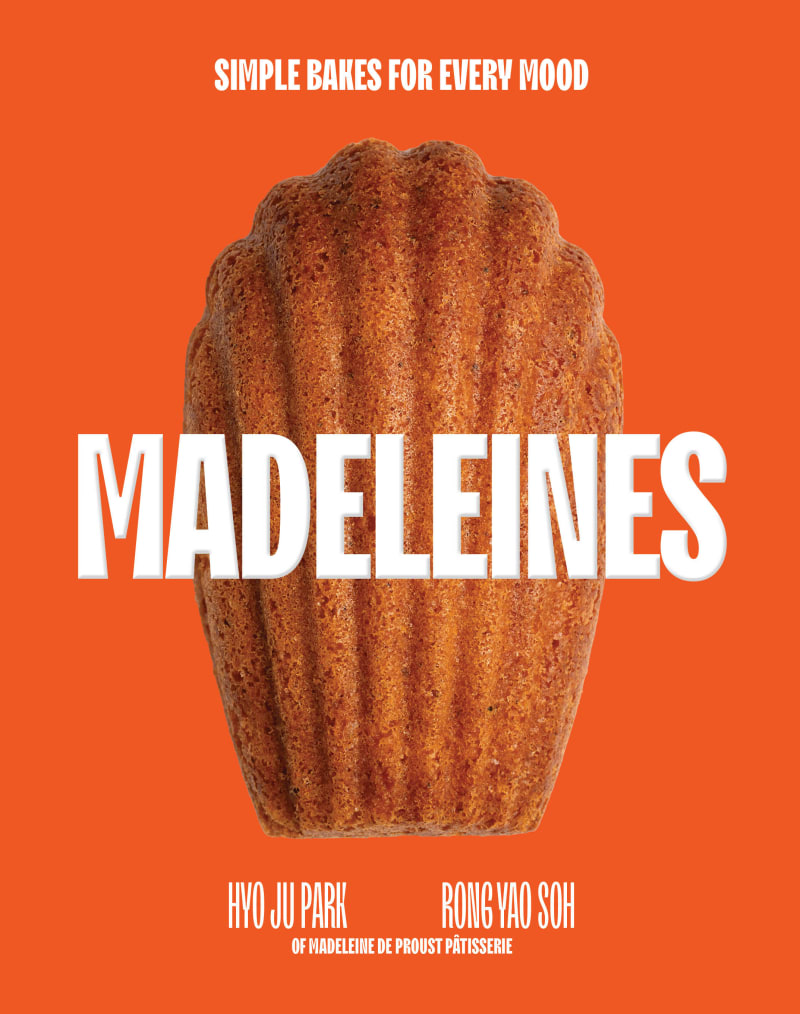
Madeleines (Hardie Grant Books, RRP $34.99) by Hyoju Park and Rong Yao Soh is out now and available at excellent independent Victorian bookstores such as Readings.